Signature Research Initiative
Retirement Fear Index™
Measuring what retirees fear most.
An ongoing initiative by David Conti, CPRC tracking the financial and emotional fears that shape retirement decisions — for retirees, pre-retirees, advisors, and the media that cover them.
Methodology
How the Index is built
The Retirement Fear Index™ combines original surveys of retirees and pre-retirees with a structured review of coaching conversations, advisor interviews, and editorial signals from the broader retirement-finance landscape.
Each release reports a composite reading anchored to December 2025 = 100, the ranked Top 10 Fears, and segment breakdowns by life stage, household type, and wealth band. The Index is descriptive, not predictive — its purpose is to make visible the emotional terrain that traditional retirement plans tend to leave unmapped.
Current Reading — October 2026
October 2026 reading
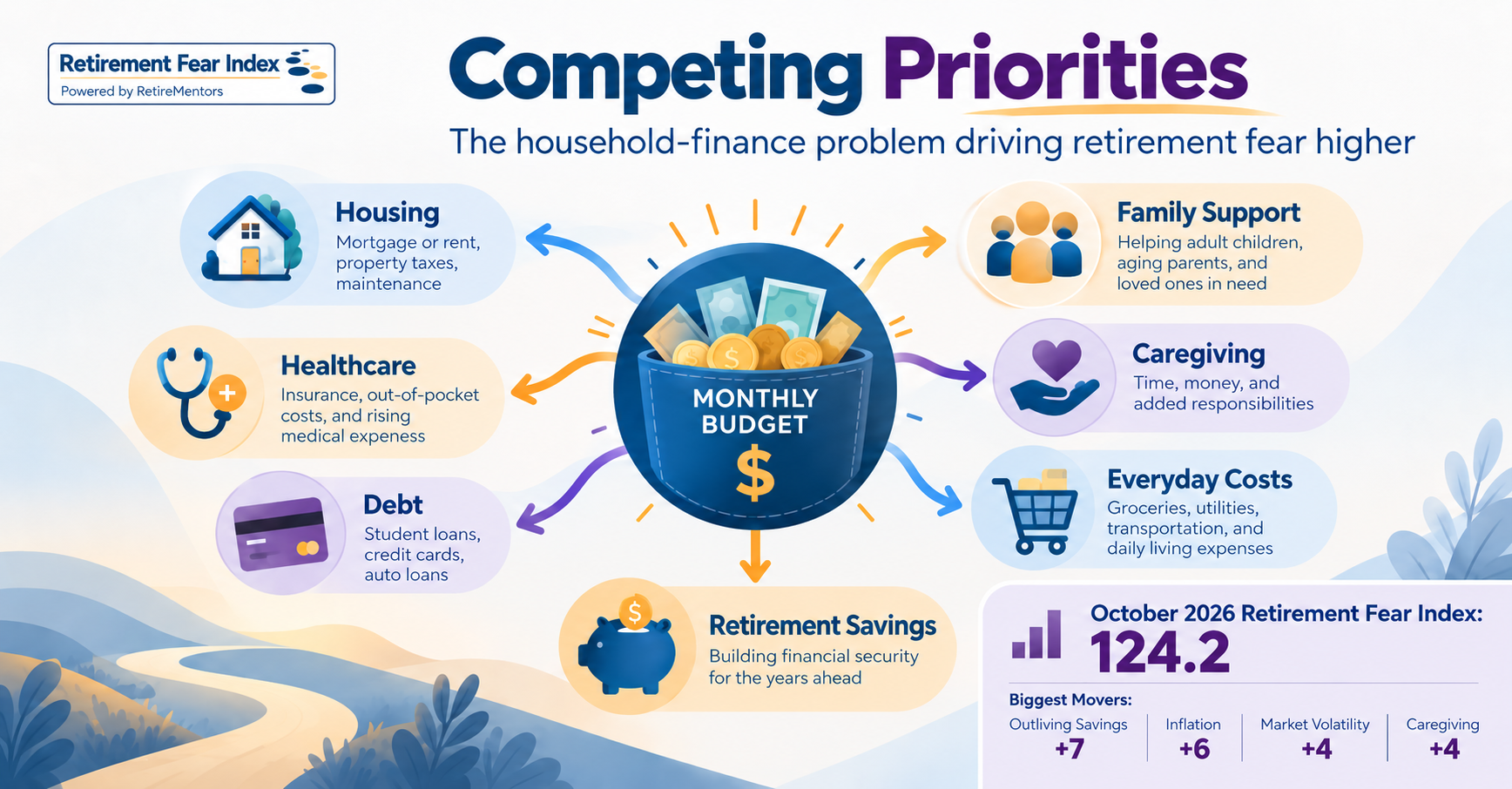
The composite reading is 124.2, about 24% above the December 2025 baseline of 100. The full month-by-month commentary is published at retirementfearindex.com.
Source: retirementfearindex.com — anchored to Dec 2025 = 100, ±2-point confidence band.
New readings publish early each month — worth checking on the 5th or 6th.
Composite Reading
124.2
Anchored to December 2025 = 100 — about 24% above baseline.
Monthly Fear Index Commentary
This month, from David
Each release comes with a short commentary — what moved in the Index, why it moved, and what it means for anyone standing at the retirement threshold. The current essay is on LinkedIn.
The Ranking
The Ten Master Fears
Each category carries a fixed weight (its share of the total fear pie) and a monthly intensity score where 100 is baseline. Readings shown for October 2026, with the change vs. the prior month.
- 01
Healthcare & Long-Term Care Costs
Healthcare and long-term care carry the largest weight in the Index.
Weight24%Intensity131▲ +1 vs. prior - 02
Outliving Savings / Longevity Risk
Longevity reframes the math toward lasting income, not just an account balance.
Weight19%Intensity128▲ +7 vs. prior - 03
Social Security & Pension Insolvency
Uncertainty about benefits and pension funding shapes retirement confidence.
Weight17%Intensity144▼ −2 vs. prior - 04
Inflation & Rising Everyday Costs
Everyday price increases can erode the purchasing power of retirement income.
Weight11%Intensity114▲ +6 vs. prior - 05
Cognitive Decline / Loss of Independence
Plans must hold up when the planner can no longer plan.
Weight7%Intensity106▼ −2 vs. prior - 06
Market Volatility & Sequence-of-Returns
Market losses early in retirement can have lasting effects when savings are being withdrawn.
Weight6%Intensity112▲ +4 vs. prior - 07
Loss of Purpose / Identity Crisis
Work scaffolding falls away; new sources of meaning must be built.
Weight5%Intensity100◆ flat vs. prior - 08
Housing Affordability & Maintenance
Aging-in-place economics are tightening.
Weight4%Intensity115▲ +3 vs. prior - 09
Family Caregiving Burdens & Isolation
Often the silent fear — and the most predictive of poor outcomes.
Weight4%Intensity110▲ +4 vs. prior - 10
Taxes & Regulatory Changes
A persistent low-grade hum across every wealth band.
Weight3%Intensity108▲ +2 vs. prior
Fifteen-month trail
Composite Index — Jul 2025 to Sep 2026
Anchored to December 2025 = 100. The line is the monthly composite of the ten master fears.
What it is
A monthly composite of ten retiree-named fears, with a ±2-point confidence band and a published methodology. Anchored to December 2025 = 100.
How it works
Translates risk concepts — longevity, sequence-of-returns, inflation, policy — into human-centered emotions people can choose to act on. Built from surveys, news signal, and event triggers.
Why it matters
Name the fear, size it against everyone else, and decide what to do. About 70% of these fears can be addressed through planning and coaching. The other 30% live in a deeper place.
Full methodology & monthly data: retirementfearindex.com
White Paper
The State of Retirement Fear — 2026 Edition
A 28-page deep-dive into the data, the stories, and the implications for retirees, advisors, and policy. Free with subscription to The Retirement Fears Newsletter.
"Retirement fears aren't irrational. They are signals. Understanding them helps us prepare, adapt, and thrive."
Get the Retirement Fear Index Newsletter in your inbox.
Each new release, plus essays from David.